
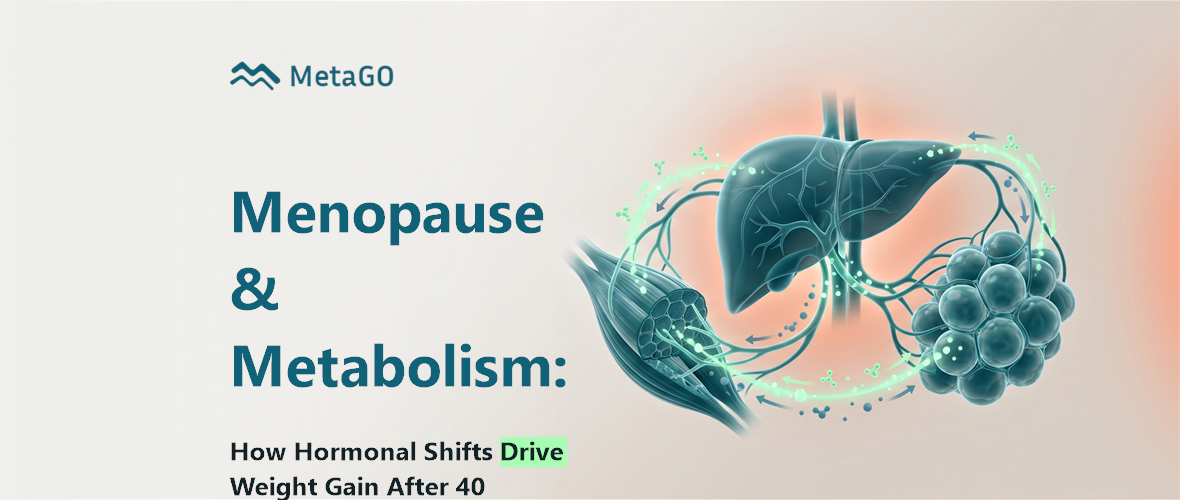
A mechanism-first guide to what actually changes inside the body during menopause, and what genuinely helps.
Key Takeaways
Menopause restructures where fat is stored and how the body uses energy. The mechanism is mainly hormonal, not behavioural.
Falling oestrogen shifts fat storage from the hips and thighs to the abdomen, independent of any change in diet.
Resting metabolic rate falls with age in everyone, by roughly 2 to 3 percent per decade, and menopause-related muscle loss can accelerate this further.
Indian women reach menopause at a national average age of 46.2 years, nearly five years earlier than the global average of 51.
The number to track is waist circumference, since 80 cm or above for women is what predicts diabetes and heart disease risk in India, not weight on a scale.
If you have noticed your waistband getting tighter around the same time your periods became irregular, you are not imagining a coincidence.
There is a real, well-documented hormonal mechanism behind it, and most of what circulates online about it is either oversimplified or borrowed wholesale from Western research that was never built with the Indian female body, Indian food patterns, or India’s earlier average age of menopause in mind.
This piece goes one level deeper than the usual five tips to beat menopause weight gain listicle. It explains the actual biology of what changes, what the evidence does and does not support, and what an Indian woman going through this transition can realistically do about it.
What Exactly Is Menopause, and What Is Happening to Your Hormones?
Menopause is the point at which a woman has gone twelve consecutive months without a menstrual period, marking the end of ovarian egg release and a sharp, permanent drop in oestrogen and progesterone production.
It is preceded by perimenopause, the transition phase that can last several years, during which hormone levels fluctuate unpredictably before settling at the lower postmenopausal baseline.
The average age of natural menopause among Indian women is 46.2 years, according to a pan-India survey by the Indian Menopause Society published in the Journal of Mid-life Health, compared with the global average of 51 years reported by Western menopause societies.
A separate systematic review and meta-analysis of Indian studies, published in Diabetes & Metabolic Syndrome: Clinical Research & Reviews, arrived at a closely matching figure of 46.6 years.
This roughly five-year gap matters for how you read advice online: a metabolic study on 52-year-old American women is describing a different stage of the same biology than what a 45-year-old Indian woman is experiencing.
Why Does Belly Fat Increase After Menopause? The Visceral Fat Mechanism
This is the single most well-evidenced mechanism in the entire menopause-metabolism picture, and it is worth understanding properly rather than as a vague hand-wave about hormones.
Before menopause, oestrogen actively directs the body to store fat in the hips, thighs, and buttocks, the subcutaneous depots, while keeping breakdown of belly fat relatively active.
A study published in Scientific Reports tracking women across the menopausal transition found that abdominal subcutaneous fat tissue changes in ways that directly correspond to increased visceral fat mass once oestrogen falls, meaning the redistribution is measurable in the tissue itself, not just on a measuring tape.
A detailed review in Nutrients lays out the chain of events: oestrogen normally helps keep visceral fat lipolysis (fat breakdown) active and pushes new fat storage toward the hips and thighs.
When oestrogen drops, fat storage shifts toward the abdomen, lipid breakdown in visceral fat becomes dysregulated, and the genes that allow fat to be properly burned for energy through beta-oxidation are switched down.
The practical result is excess free fatty acids circulating in the blood, which is one of the direct drivers of insulin resistance, documented in this comprehensive review of energy metabolism changes in postmenopausal women.
This pattern was confirmed at scale in a 2026 study published on PMC, which tracked body composition across the menopausal transition and found that visceral fat area in normal-weight women rose from an average of 36.4 cm² before menopause to 55.7 cm² after, a real and measurable shift, alongside a documented clear shift toward lower lean mass and greater central adiposity in the study’s own conclusions.
This is why the same body weight before and after menopause can carry meaningfully different health risks; the fat has moved to a more metabolically dangerous location, not just to a different spot on the body.
Does Menopause Actually Slow Your Basal Metabolic Rate?
Basal metabolic rate, often shortened to BMR, is the energy your body uses at complete rest simply to keep your organs, brain, and cells functioning.
It typically accounts for 50 to 70 percent of total daily calories burned in a sedentary adult, according to Harvard Health’s review of metabolism and ageing research, which makes it the single largest lever in daily energy balance.
Here the evidence is more nuanced than most articles let on, and worth stating honestly rather than oversimplified.
A widely cited review in Acta Obstetricia et Gynecologica Scandinavica found that resting metabolic rate declines by roughly 2 to 3 percent per decade with normal ageing in research on menopause, energy expenditure and body composition, and that this decline appears to accelerate during the menopause transition specifically, alongside an accelerated loss of fat-free (muscle) mass.
A more recent study published in the Journal of Clinical Endocrinology and Metabolism adds an important complication: when researchers adjusted for age, they found age, not menopausal status itself, was the stronger predictor of lower resting energy expenditure, as reported in this JCEM study on age, menopause and resting energy expenditure.
The honest summary: metabolism slows with age regardless of menopause, and menopause adds its own additional pressure on top through muscle loss and fat redistribution, rather than menopause alone being a separate, isolated cause of a slower metabolism.
Muscle loss is the connecting thread. Skeletal muscle is metabolically active tissue; it burns calories even at rest, far more than fat tissue does.
A clinical review on muscle and ageing in Frontiers in Physiology found that the rate of muscle loss after midlife runs at roughly 0.37 to 0.47 percent per year in women under normal ageing, documented in this quantitative review of sarcopenia and ageing muscle, and oestrogen decline is independently linked to reduced muscle protein synthesis on top of this baseline rate.
Less muscle means a lower resting calorie burn, which compounds the visceral fat shift described above.
What Are the Indian Numbers That Actually Matter Here?
Generic global thresholds understate risk for Indian women, because South Asian bodies develop metabolic complications at lower body fat levels than Western reference populations.
The Indian obesity guidelines, updated in 2025 by experts from AIIMS Delhi and the National Diabetes, Obesity and Cholesterol Foundation, set out the numbers that should guide a woman tracking her own risk through menopause.
| Measure | Indian threshold for women | Why it matters at menopause |
| BMI (overweight) | 23 kg/m² or above | Lower than the old global cut-off of 25, reflecting earlier metabolic risk in South Asian bodies |
| BMI (obesity) | 25 kg/m² or above | Stage 1 obesity in the 2025 Indian framework |
| Waist circumference | 80 cm or above | Captures the visceral fat shift that menopause specifically drives, even if BMI looks unchanged |
| Waist-to-height ratio | 0.5 or above | An additional check when waist measurement alone is borderline |
This is also why waist circumference is the number worth tracking through menopause specifically, more than weight on a scale.
Because fat is actively redistributing toward the abdomen during this transition, a woman’s weight can stay flat while her waist measurement and her metabolic risk both climb.
What Is Metabolic Syndrome, and Why Does Menopause Raise the Risk?
Metabolic syndrome is not a single disease but a cluster of risk factors that, together, sharply raise the risk of type 2 diabetes and heart disease.
Under the widely used NCEP ATP III criteria, a diagnosis requires three or more of five markers, as set out in this peer-reviewed comprehensive review of metabolic syndrome definitions:
- Abdominal obesity, measured by waist circumference (the Indian threshold of 80 cm or above for women applies here)
- Elevated fasting triglycerides
- Low HDL (protective) cholesterol
- Elevated blood pressure
- Elevated fasting blood glucose
Menopause raises the odds of crossing several of these thresholds simultaneously, because the same hormonal shift that redistributes fat to the abdomen also independently worsens insulin sensitivity and blood lipid patterns, as the mechanism review in Nutrients cited above documents.
This is the clinical reason menopause is treated as a genuine risk window for metabolic syndrome, rather than just a phase of unwelcome weight gain.
So What Actually Helps During This Transition?
The evidence points consistently toward two levers that address the mechanism directly, rather than fighting it indirectly.
Protect and rebuild muscle
Because muscle loss is a direct contributor to the falling resting metabolic rate described above, resistance training is the single most mechanism-targeted intervention available.
It does not need to mean a gym membership. Bodyweight strength work, resistance bands, or carrying and lifting through daily activity all count, provided the muscle is genuinely being loaded and challenged a few times a week.
Eat with protein and fibre as the anchor, not as an afterthought
A higher protein intake supports the muscle-preserving effect of resistance training and helps offset the natural decline in muscle protein synthesis linked to falling oestrogen.
For an Indian plate, this does not require imported superfoods. Dals, paneer, curd, sprouted moong, eggs, and fish, where eaten, are all accessible, India-correct protein sources that fit existing dietary patterns rather than replacing them with Western templates.
Track the waist, not just the weight
Given that the central mechanism is fat redistribution rather than simple fat gain, a tape measure around the waist tells a more complete story through this transition than a weighing scale does on its own.
When Does This Become a Conversation Worth Having With a Doctor?
For most women, the changes described here are a normal, manageable part of midlife and respond well to the muscle and nutrition levers above.
But when waist circumference has clearly crossed the 80 cm threshold, when weight gain has progressed to a BMI of 25 or above despite consistent effort, or when fatigue, irregular blood sugar, or other metabolic symptoms have appeared alongside the menopausal transition, this moves from a lifestyle question to a clinical one.
In that situation, the right step is a proper clinical assessment rather than self-directed trial and error. A doctor can evaluate whether the weight gain has crossed into clinical obesity, check for metabolic syndrome markers directly through blood work, and discuss the full range of medically supervised options that exist for users in that category, which for some, after a full evaluation, may include a discussion of the GLP-1 mechanism among other approaches a doctor considers appropriate.
This is a decision for a qualified clinician to make with you, not something to self-diagnose from an article.
Frequently Asked Questions About Menopause Metabolism
What does menopause actually mean?
Menopause is the point at which a woman has had no menstrual period for twelve consecutive months in a row, marking the permanent end of ovarian egg release and a sustained drop in oestrogen and progesterone.
What is metabolism, in simple terms?
Metabolism is the sum of all the chemical processes your body uses to convert food into energy, including the energy spent simply staying alive at rest, known as the basal metabolic rate.
At what age do Indian women typically reach menopause?
The national average is 46.2 years, according to a pan-India survey by the Indian Menopause Society, nearly five years earlier than the global average of 51 years.
Can metabolism be increased after menopause, or only protected from further decline?
Resting metabolic rate cannot be reversed to a younger baseline, but the muscle-related portion of the decline is genuinely responsive to resistance training, since added muscle mass does increase resting calorie expenditure.
Is belly fat after menopause just about diet, or is it hormonal?
It is substantially hormonal. Falling oestrogen directly changes how and where fat is broken down and stored, shifting the body’s preference toward the abdomen even when diet and activity stay constant.
Want India-Correct Health Insight in Your Inbox?
MetaGo Health publishes mechanism-first, India-specific guidance on metabolic health, written for Indian bodies and Indian data, not adapted from Western defaults. Subscribe to get the next piece in this series as soon as it publishes.
Medical Disclaimer
This article is for educational purposes only and is not a substitute for professional medical advice, diagnosis, or treatment. Menopause symptoms and metabolic risk vary significantly between individuals. Always consult a qualified physician before making decisions about your health, including any decision related to diet, exercise intensity, or treatment options.
The Bottom Line
Menopause does not simply slow you down; it redirects how and where your body stores and burns energy, through a well-documented oestrogen-driven shift toward visceral fat and a muscle loss that compounds the natural metabolic slowdown of aging.
For Indian women, this shift typically begins nearly five years earlier than the Western data most online advice is based on, and the threshold that matters most to track is a waist circumference of 80 cm, not the number on a scale.

